If the U.S. Latino cohort were its own country, it would be the 4th largest economy in the world. According to the 2026 LDC U.S. Latino Economic Impact Report (Arizona State University, Seidman Research Institute), U.S. Latino GDP reached $4.4 Trillion in 2024 — larger than Japan, India, the U.K., France, Italy, and Canada. And it is the fastest-growing among all major economies.
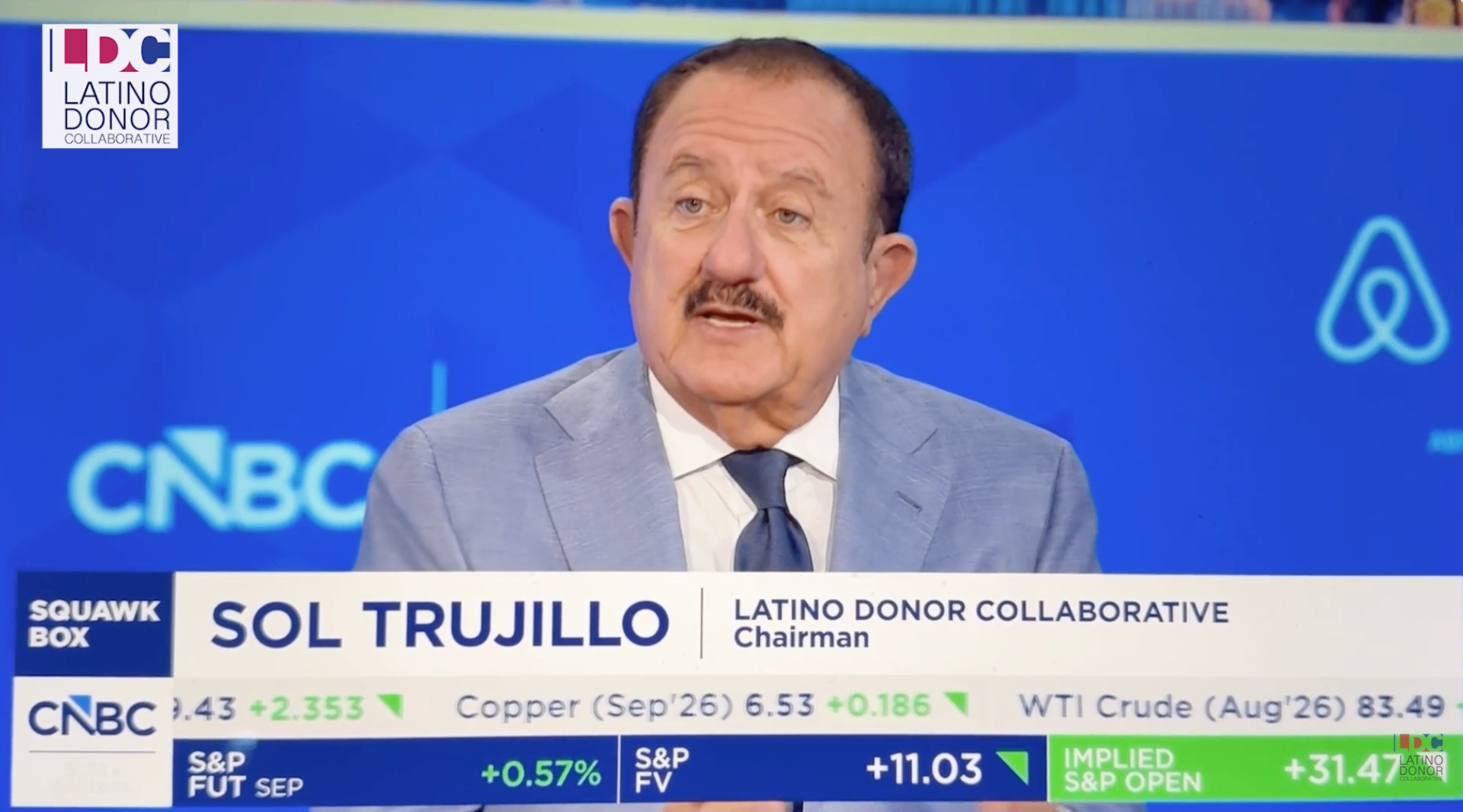
Sol Trujillo on CNBC: "Who's Buying? Who Has Market Share?"
Sol Trujillo — founding chairman of the Latino Donor Collaborative and former CEO of US West and Telstra — appeared on CNBC to break down what a $4.4T Latino economy actually means for capital allocators, brand marketers, and boardrooms. His challenge to Wall Street and Fortune 500 CMOs was direct: if you can't answer who is driving the growth, you can't deploy capital against it.
"The question is who's buying? Who has the market share? And if I were on the buy side or sell side of the equation, I'd be spending time to look at what's happening."
— Sol Trujillo, Chairman, Latino Donor Collaborative — CNBC
A $4.4T Economy — Ranked Against the World
Ranked as a standalone economy, U.S. Latinos would sit at #4 globally — behind only the U.S., China, and Germany, and ahead of Japan, India, and the U.K. It is not a niche segment. It is a top-tier world economy operating inside the U.S. border.
U.S. Latino GDP vs. World Economies (2024)
Trillions of USD
Source: LDC 2026 U.S. Latino Economic Impact Report / ASU Seidman Research Institute
Income Is Compounding 2x Faster Than Non-Latinos
U.S. Latino Gross Domestic Income (GDI) reached $3.4 Trillion, growing +8% year-over-year — 2x faster than non-Latinos. The median Latino age is 16–20 years, meaning this income base is positioned to compound for decades. This isn't a peaking cohort. It's the earliest innings.
Annual GDI Growth Rate (%)
U.S. Latino vs. Non-Latino, 2024
Source: LDC 2026 U.S. Latino Economic Impact Report
The 3rd Largest Consumer Market in the World
U.S. Latino household consumption hit $2.8 Trillion — the 3rd largest consumer market on the planet, spending more than Germany and India. Inflation-adjusted consumption grew nearly 3x the non-Latino rate from 2019–2024. And in 2025, Latino households drove 92.6% of all U.S. household formation — nearly every new American household is Latino.
Real Consumption Growth 2019–2024 (%)
Inflation-adjusted annual consumption growth
Source: LDC 2026 U.S. Latino Economic Impact Report
Local Latino Economies Drive State Growth
The Latino GDP contribution is heavily concentrated in the most economically important states. California alone posts a Latino GDP of over $1 Trillion. U.S. Latinos account for:
- 53% of California's GDP growth
- 37% of Florida's GDP growth
- 36% of New York's GDP growth
- 32% of Texas' GDP growth
Top Latino GDP by State — 2024
Billions of 2024 USD
Source: LDC 2026 U.S. Latino Economic Impact Report
The Workforce Powering U.S. Growth
The U.S. Latino working-age population grew +4.9% year-over-year — compared to just +1.5% for the overall U.S., +0.9% among the Black population, and a −0.5% decline among non-Hispanic Whites. In effect, Latinos account for two-thirds of all U.S. working-age population growth. Without this cohort, the U.S. workforce would be shrinking.
Working-Age Population Growth YoY (%)
By demographic cohort
Source: LDC 2026 U.S. Latino Economic Impact Report
High-Velocity Entrepreneurship
There are 5.7 million Latino-owned employer businesses in the U.S., forming new firms 2.5x faster than the national average. Between 2012 and 2022, U.S. Latinos created three of every ten new businesses in America.
Why This Matters for Every Brand
A $4.4T economy growing at 2x the national rate isn't a "diversity initiative" — it is where the incremental revenue lives. But reaching it takes dedicated campaigns, culturally-fluent messaging, and in many cases, Spanish-language creative. Generic media plans don't work here. The brands winning market share are the ones running Hispanic-specific strategies with intent — the rest are quietly losing share to competitors who show up on purpose. If you're not building for this consumer, you're leaving significant revenue on the table.
- Dedicated media plans, not general-market spillover
- Culturally-fluent creative — not translated ads
- Spanish-language distribution where the audience actually consumes content
- Measurement frameworks that isolate Hispanic performance
The Bottom Line
U.S. Latinos are the world's 3rd largest spending economy, with the fastest-growing incomes of any cohort. Their economy is the single most powerful growth engine in America — making its prosperity inseparable from the nation's. As Sol Trujillo put it on CNBC: the question is who's buying. The answer is clear. The only question left is whether your brand is showing up.